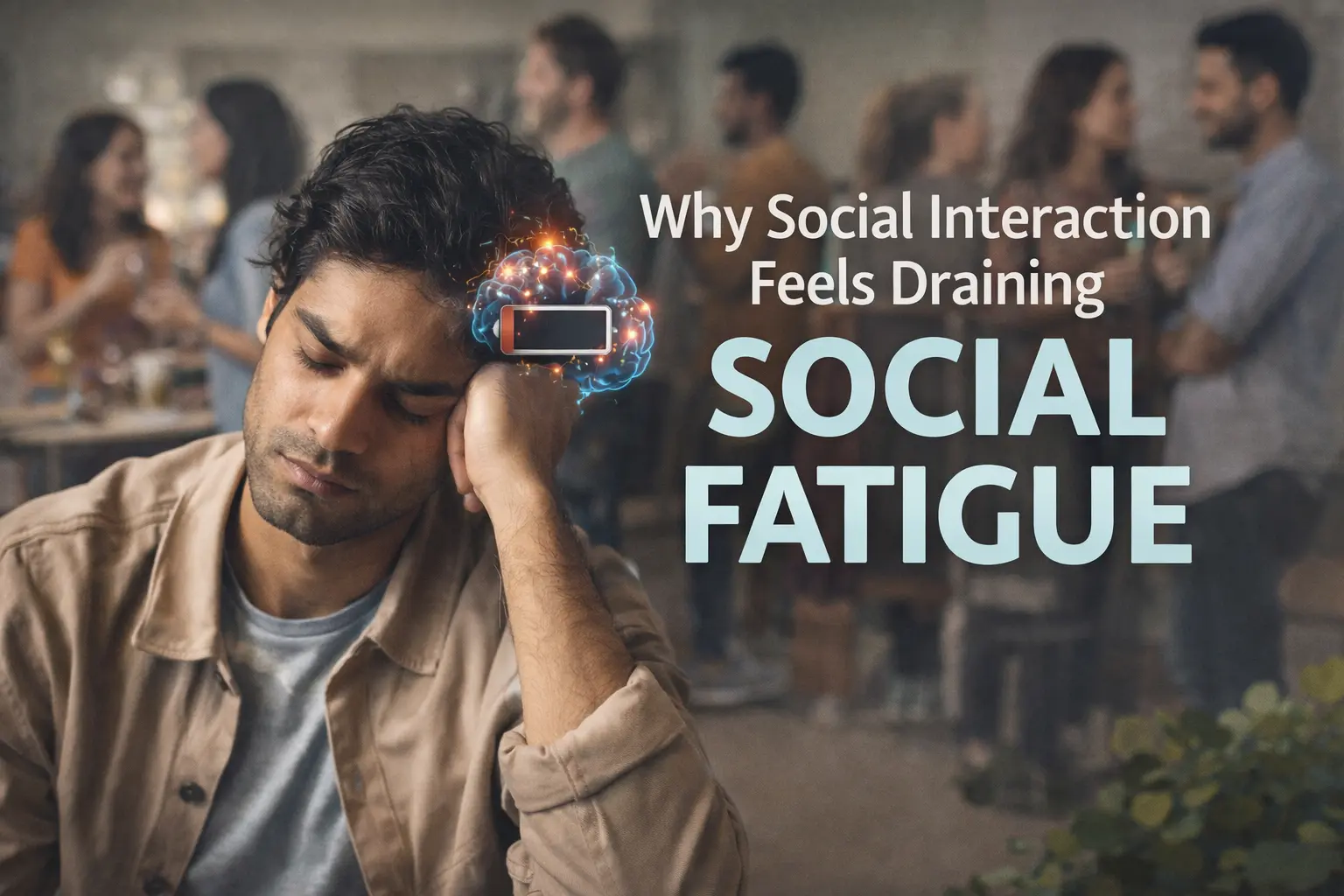
Over the past few years, an increasing number of people have shared a similar concern in therapy rooms and everyday conversations alike: “I want to meet people, but I feel exhausted afterwards.” This experience is now commonly referred to as social fatigue - a state of emotional, mental, and sometimes physical exhaustion following social interaction. While social connection remains essential for mental health, many people today find that it no longer feels as energising as it once did.
What Is Social Fatigue?
Social fatigue is not about disliking people or avoiding relationships. Rather, it reflects the effort required to process, respond, regulate emotions, and stay mentally engaged during social interactions. The human brain treats social engagement as a complex task, it involves attention, memory, emotional reading, self-monitoring, and regulation of stress responses. When these systems are already under strain, socialising can feel tiring instead of nourishing.
This fatigue is not a clinical diagnosis, but it is a very real psychological and neurobiological experience, especially in the context of modern life.
Why does socialising feel more exhausting now?
Several converging factors have made social fatigue more common and more intense in recent years:1. Chronic mental overload
We live in a state of continuous stimulation - messages, notifications, news updates, and social media interactions keep the brain in a constant “on” mode. This leaves little room for recovery. When the brain does not get sufficient rest, even basic social interaction can feel demanding.2. Post-pandemic changes in social regulation
The COVID-19 pandemic disrupted social routines, safety cues, and predictability. For many, the nervous system adapted to isolation and reduced stimulation. As social life resumed, the shift back was not always smooth. The brain now tires faster when exposed to crowds, conversations, and emotional exchange.3. Emotional labour in everyday interactions
Socialising today often involves managing impressions, being careful with words, staying emotionally appropriate, and constantly monitoring reactions. This emotional labour, especially when combined with stress at work or home, adds to exhaustion.4. Digital world vs real world
Online interactions require less sensory and emotional processing compared to in-person contact. As a result, the nervous system becomes accustomed to low-effort connection, making real-life interactions feel disproportionately demanding.Our brains are getting used to quick, effortless digital stimulation, while real conversations need patience and attention. That gap is making socialising feel exhausting.
Is social fatigue limited to certain age groups?
Social fatigue cuts across age groups, but it shows up differently. • Gen Z often experiences fatigue related to social comparison, identity pressure, and constant evaluation, amplified by digital platforms. Many also had limited opportunities to practise real-world social skills during critical developmental years. • Millennials commonly report fatigue due to role overload, balancing work, family, caregiving, and financial pressures. Socialising can feel like another responsibility rather than a source of relief.Could social fatigue be related to a personality type?
We often think introverts enjoy social interactions less than extroverts and as a corollary may associate social fatigue to a personality type. But that’s not always the case. Introverts and extroverts differ in how much stimulation their brains naturally prefer, not in how strong or stress-resilient they are. Even socially confident, outgoing individuals experience exhaustion when interactions become emotionally demanding or when there is insufficient recovery time. Similarly, introverted individuals may enjoy social connection deeply but need adequate space to restore balance. Social fatigue is therefore state-dependent, not personality-dependent.What can be done?
Managing social fatigue does not mean withdrawing from relationships. It means relating differently. • Choose quality over quantity in social interactions. • Allow yourself recovery time after meeting people, without guilt. • Reduce the pressure of constant availability—online and offline. • Be honest about your energy levels instead of pushing through exhaustion. • Notice which interactions feel safe, calm, and restorative—and prioritise them.From a mental health perspective, social fatigue is often a signal, it reflects a nervous system asking for slower pacing, clearer boundaries, and more authentic connection.
Conclusion
Feeling tired after socialising does not mean you are antisocial, weak, or failing at relationships. In many cases, it means you are responding normally to an overstimulating, high-demand world. Learning to listen to this signal is an important step toward emotional well-being.Social connection remains vital to mental health but in today’s world, it needs to be intentional, balanced, and humane, both to ourselves and to others.