
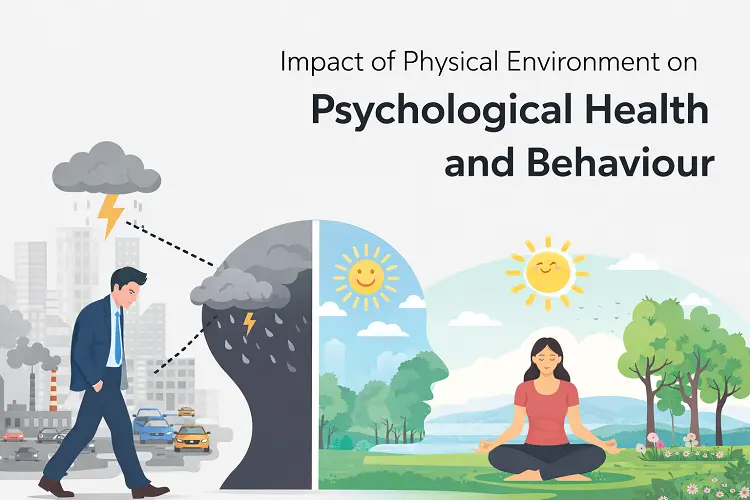
Physical places are never neutral. The buildings we live and work in, the streets we move through, the noises we wake to, the light that fills our rooms, and the green patches we can reach all speak to our nervous system. Over time those sensory messages shape our moods, our habits, how we relate to others and even how we think about ourselves. This blog explains, in practical and evidence-based terms, how environments produce psychological effects, what the strongest research shows, and what that means for clinicians, policymakers, and everyday people.
The basic idea: environment as ongoing feedback to the brain
Think of the environment as a continuous, low-level conversation with your brain. A noisy, overcrowded apartment tells your threat systems to stay alert; a neat, sunlit kitchen sends a quiet signal that things are controllable. These signals are subtle and cumulative. They do not usually cause immediate psychiatric illness on their own, but they bias how people cope, what behaviours become habitual, and how people evaluate themselves. Over months and years, those biases influence mood regulation, attention, social trust and the felt sense of agency.
This is consistent with work in environmental psychology and public health showing that chronic exposure to adverse conditions (crowding, poor indoor climate, persistent noise) raises distress and physiological stress markers, while access to natural or restorative features reduces stress and improves attention and recovery.
How environments influence mind and behaviour - the mechanisms
There are several overlapping mechanisms by which place affects psychology:Neurobiological arousal and stress regulation:
Persistent noise, crowding, poor sleep, or unsafe neighbourhood cues keep the sympathetic nervous system and the HPA axis more active. That makes people more reactive, less patient, and more likely to use short-term coping strategies (substance use, social withdrawal) that feel stabilizing but worsen mood over time. Longstanding experimental and epidemiological work links crowding and chronic noise exposure to higher stress and worse mental health outcomes.Attention and cognitive restoration:
Urban life demands extended directed attention and we deal with distractions all day. Natural environments provide a different kind of attention (soft fascination) that lets directed attention recover. This Attention Restoration Theory explains why access to greenery improves concentration, reduces mental fatigue, and lowers irritability in many studies. Classic experimental work and later systematic reviews support this restorative effect.Social affordances and behaviour shaping:
Built environments structure where interactions can happen. Walkable streets, parks, markets and community centers create low-cost opportunities for casual social contact and mutual help; poorly designed or segregated areas reduce incidental social exchange and increase isolation. Over time this changes social norms and personality-relevant behaviours. People in connected environments tend to be more trusting and socially engaged; in disconnected environments the opposite pattern is common. The role of social determinants is central in major public health syntheses.Perception and identity:
Spaces communicate value and belonging. Living in neglected housing or constantly moving between temporary places can erode self-worth and continuity of identity, while environments that allow personalization and cultural resonance support a coherent self-narrative. The World Health Organization’s housing guidelines and multiple public health reports emphasize the mental health relevance of adequate, stable housing.What the strongest evidence shows (practical highlights)
Housing crowding and poor housing conditions increase psychological distress and interfere with sleep and family functioning; these effects appear across income levels but are concentrated in disadvantaged groups. The built environment literature summarizes decades of findings linking crowding, poor light and damp/harmful housing conditions to higher distress.Noise is not just an annoyance
Road, rail and aircraft noise associate with higher risk of anxiety, depression and cardiovascular stress; each incremental increase in chronic noise exposure shows measurable odds of worse mental health and physiologic strain in meta-analytic studies. Noise harms sleep and raises physiological arousal, mechanisms relevant to both mood and cognition.Green space helps. Multiple systematic reviews and meta-analyses find that proximity and access to green spaces reduce symptoms of depression and anxiety, improve subjective wellbeing, and support cognitive restoration. Even brief exposure (10–30 minutes) to natural settings is associated with measurable reductions in cortisol and improved attention in several studies.
Design for social contact matters. Cities and neighbourhoods that allow casual interaction (benches, markets, civic spaces, walkable streets) support social cohesion and reduce loneliness; conversely, long commutes, segregation, and lack of public spaces contribute to social isolation, which is itself a robust predictor of poor mental and physical health. The Lancet’s work on global mental health and social determinants highlights these links between place, social risk and mental health outcomes.
Healthcare and housing integration is essential. When people with severe mental illness cannot access stable housing, clinical outcomes worsen and system costs increase (delayed discharges, readmissions). Recent policy reporting in several countries has reinforced how housing shortages and poor supported housing worsen mental health system functioning.
Clinical implications — what clinicians should notice and do
Ask about environment as a standard part of assessment. Housing quality, crowding, noise exposure, commute time, access to green space, and feelings of safety are not peripheral details; they shape risk and recovery trajectories.When feasible, integrate place-level interventions into care plans. This can be simple: advise on sleep hygiene that reduces noise-related arousal, suggest micro-doses of nature exposure (walking in a park 10–20 minutes three times a week), or connect patients to housing support and community resources. For severe cases, advocate for supported or stable housing as an element of treatment planning; evidence shows that addressing housing directly improves outcomes.
Collaborate across sectors. Effective mental health promotion requires working with urban planners, public health officials, housing authorities and community organisations. Clinicians can offer evidence-based input on how design choices affect stress, social connection and recovery.
Policy and urban planning implications
If mental health is treated only at the clinical level, we miss the upstream causes. Urban policy should prioritize safe, affordable, and stable housing; preserve and expand urban green spaces; mitigate environmental noise; design for walkability and incidental social contact; and ensure accessible public transport to reduce chronic stressors like long commutes.The World Health Organization has explicit guidance linking housing to health outcomes, and major public health commissions stress social determinants as core targets for mental health improvement. Translating that into building codes, transit design, and housing policy is essential investments in supportive environments pay back in reduced healthcare burden and improved population wellbeing.
Gaps and open questions for researchers
Many studies are cross-sectional, making causal interpretations cautious. We need more longitudinal, natural-experiment and intervention studies that measure mental health before and after environmental changes (new parks, noise abatement, housing upgrades). Dose–response relationships (how much green time is needed, how much noise reduction matters) require further precise quantification, and cultural differences in place-effects are still underexplored.There is also a need to integrate biological markers (sleep, cortisol, inflammation) with lived-experience measures and social network mapping to produce richer models of how place “gets under the skin.”
Practical advice for individuals (evidence-informed, feasible actions)
You don’t have to move to improve mental health. Small changes matter: create predictable sleep spaces (earplugs, blackout curtains), get brief regular exposure to nearby green spaces, reduce clutter and add light where possible, and seek community activities that let you meet neighbours in low-pressure settings. If housing is unsafe or overcrowded, reach out to community or health services; housing stability is a legitimate clinical concern, not just a social one.Clinicians should consider screening for environmental risk and documenting it as part of social determinants. Advocacy for patients’ housing needs is both clinically relevant and evidence-supported.